To understand the true significance of building cleaning services in Singapore’s commercial property landscape, one must first grasp a fundamental truth that often escapes casual observers: the cleanliness of a building is never merely about cleanliness. It is about power, about property values, about the unspoken hierarchies that govern who works where and under what conditions. It is about the invisible infrastructure that allows Singapore’s relentless economic engine to function day after day, the workers who arrive before dawn and depart after dusk, the systems and contracts and relationships that determine whether a tower gleams or deteriorates. The story of commercial cleaning is, in essence, a story about how modern cities actually work.
The Infrastructure Behind the Infrastructure
In the years following Singapore’s rapid development as a financial and commercial hub, a parallel industry emerged, one that few people noticed but upon which everything depended. Building cleaning services grew from small-scale operations into sophisticated enterprises managing vast networks of workers, equipment, and schedules. This transformation did not happen by accident. It resulted from deliberate policy decisions, market forces, and the inexorable logic of urban densification.
Consider the mathematics of the situation. A typical commercial tower in Singapore’s Central Business District might house three thousand workers across forty floors. Each day, those workers generate waste, soil surfaces, use facilities, and leave traces of their presence. Without systematic cleaning, the building would become uninhabitable within days, perhaps hours. The cleaning operation required to maintain such a structure demands coordination rivalling that of the businesses it serves.
The Anatomy of Commercial Property Maintenance
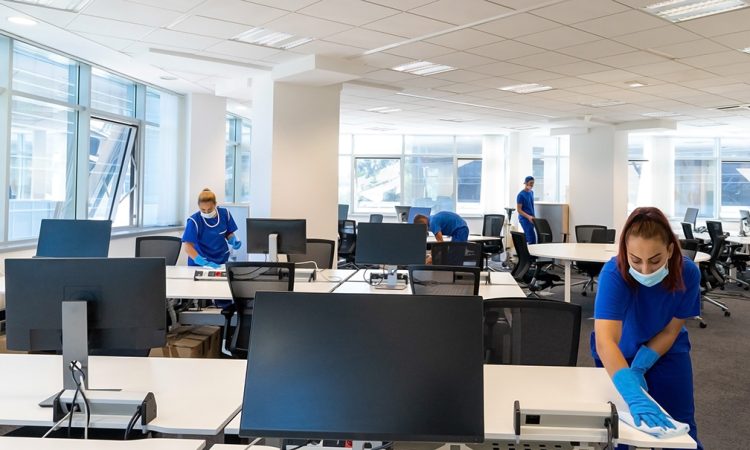
Professional commercial building cleaning encompasses far more than the visible tasks most people associate with the work. To truly understand the scope, one must examine the complete range of services that keep modern commercial properties functioning:
- Daily cleaning of office spaces, workstations, and circulation areas
- Comprehensive washroom maintenance and sanitation
- Floor care including vacuuming, mopping, and specialised treatments
- High-dusting of fixtures, vents, and elevated surfaces
- Glass and window cleaning for interior partitions
- Common area maintenance including lobbies and meeting spaces
- Waste management and recycling coordination
- Periodic deep cleaning of carpets, upholstery, and fixtures
- Specialised cleaning for kitchens, pantries, and food service areas
Each of these tasks requires specific training, equipment, and procedures. The workers who perform them possess knowledge accumulated through experience, passed down through training programs, refined through trial and error. This expertise represents genuine skill, though it often goes unrecognised by those who benefit from it daily.
The Power Dynamics of Service Contracts
The relationship between property owners and building cleaning service providers reveals much about how power operates in commercial real estate. Property managers, under pressure to control costs whilst maintaining standards, wield considerable leverage in contract negotiations. Cleaning firms, competing for lucrative long-term contracts, face intense pricing pressure. These dynamics inevitably affect the workers themselves, whose wages, working conditions, and job security hang in the balance of negotiations they never participate in.
Singapore’s regulatory framework attempts to address these imbalances through minimum wage requirements, mandatory training standards, and workplace safety regulations. Yet enforcement remains uneven, and the structural pressures that drive cost-cutting persist. The result is a system where the quality of building maintenance services varies considerably, despite superficial similarities in contract specifications.
The Technology of Modern Cleaning
Over the past two decades, commercial cleaning services have undergone technological transformation. Automated floor scrubbers navigate corridors with increasing sophistication. Microfibre materials replace traditional cloths, improving efficiency whilst reducing chemical usage. Water purification systems enable streak-free glass cleaning with minimal environmental impact. Scheduling software optimises worker deployment, reducing labour costs whilst theoretically improving coverage.
These technological advances promise improvements in both efficiency and environmental sustainability. Yet they also raise questions about employment. As automation increases, what happens to the workers who currently perform tasks that machines can replicate? Singapore has not adequately confronted this question, preferring to celebrate innovation without reckoning with its human costs.
The Environmental Reckoning
The environmental implications of large-scale building cleaning operations demand scrutiny. Traditional cleaning methods consumed vast quantities of water, relied on chemical products with questionable environmental profiles, and generated significant waste. Singapore’s water scarcity and environmental vulnerabilities make these concerns particularly acute.
Progressive cleaning services have adopted greener practices, yet adoption remains incomplete. The market rewards lowest-cost providers, not environmental leaders. Without stronger regulatory requirements or shifts in procurement priorities, the transition to truly sustainable facility cleaning services will remain frustratingly slow.
The Question of Value
Property owners frequently view cleaning as a cost to minimise rather than an investment to optimise. This perspective, whilst understandable given competitive pressures, misses essential truths. Well-maintained buildings command higher rents, attract better tenants, and require less frequent major repairs. Poor maintenance accelerates deterioration, ultimately costing far more than preventive care would have required.
The calculation extends beyond individual properties. Singapore’s reputation as a clean, well-managed city state contributes to its competitive advantage in attracting investment and talent. That reputation rests partly on the cumulative effect of thousands of well-maintained buildings, the product of professional building cleaning services performed largely out of sight.
Conclusion
The towers that define Singapore’s skyline represent ambition, capital, and architectural achievement. Yet they would deteriorate into hulks without the invisible army of cleaning workers who maintain them, the companies that coordinate that labour, and the systems that govern the entire operation. Understanding building cleaning services means understanding power, economics, and the unglamorous but essential work that sustains modern urban life. It means recognising that cities function not through grand gestures but through countless small tasks performed reliably, day after day, by people whose contributions rarely receive acknowledgment. The next time you walk through a gleaming commercial lobby, consider the human effort required to maintain that shine, and ask yourself whether we adequately value the workers and systems that make it possible. That question lies at the heart of any honest discussion about building cleaning services.