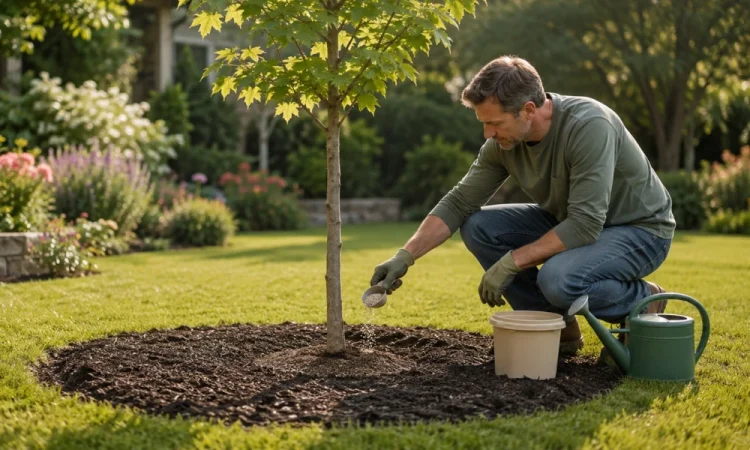
Planting a tree is an investment in the future of a landscape. During its first few years, a young tree must establish new roots, adapt to its surroundings, and recover from transplanting stress. Fertilizer may support this process in certain situations, but applying too much-or using it unnecessarily-can interfere with healthy establishment.
The following fertilization tips can help newly planted trees develop strong roots without encouraging excessive or unbalanced growth.
Do Not Fertilize Automatically
New trees do not always need fertilizer immediately after planting. Many nursery-grown trees already contain enough stored nutrients to support their initial growth. If the surrounding soil provides adequate nutrition, additional fertilizer may offer little benefit.
In fact, applying a high-nitrogen product at planting time can encourage rapid leaf and shoot growth before the root system is ready to support it. This imbalance may increase water demand and make the tree more vulnerable to drought, heat, and other environmental stress.
Unless a nutrient deficiency has been identified, it is often best to let the tree begin establishing before introducing fertilizer.
Test the Soil First
A soil test is the most reliable way to determine whether fertilizer is necessary. Testing can reveal the soil’s pH, nutrient levels, and other conditions that influence nutrient availability.
Visual symptoms such as pale leaves, slow growth, or small foliage may suggest a deficiency, but they can also result from overwatering, drought, compacted soil, root damage, or improper planting depth. Adding fertilizer without identifying the underlying cause may fail to correct the problem and could make conditions worse.
Soil-test results can guide the selection of an appropriate product and application rate.
Prioritize Watering and Mulching
For most newly planted trees, proper watering is more important than fertilization. The root ball and surrounding soil should remain consistently moist but not waterlogged during the establishment period. Water slowly and deeply so moisture reaches the developing root zone.
A layer of organic mulch can help conserve soil moisture, regulate temperature, and reduce competition from grass and weeds. Spread mulch in a broad ring around the tree, but keep it several inches away from the trunk. Piling mulch against the bark can trap moisture and contribute to decay.
Healthy roots require water, oxygen, and suitable soil structure before they can effectively use added nutrients.
Choose the Right Fertilizer
When testing confirms that fertilizer is needed, choose a slow-release product formulated for trees or woody plants. Slow-release nutrients become available gradually, reducing the risk of root injury and excessive shoot growth.
Avoid products that contain unnecessarily high nitrogen levels. More fertilizer does not produce a healthier tree. Excess nutrients can burn roots, contaminate nearby waterways, promote weak growth, and contribute to nutrient imbalances.
Always follow the product label and use the lowest effective application rate. Fertilizer should never be placed directly into the planting hole unless specifically recommended based on soil conditions and product instructions.
Apply Fertilizer Across the Root Zone
Tree roots spread outward rather than remaining next to the trunk. Fertilizer should therefore be distributed evenly over the soil around the tree instead of being concentrated at its base.
Keep granular fertilizer away from the trunk and apply it across the accessible root zone, following label directions. Watering after application may help move nutrients into the upper soil, provided the product instructions recommend it.
Fertilizer spikes can concentrate nutrients in a few locations and may not provide even coverage. A measured surface application is often more appropriate.
Select the Proper Time
Early spring, shortly before active growth begins, is commonly a suitable time to fertilize when nutrients are genuinely needed. In some climates, late fall may also be appropriate after shoot growth has stopped but while roots remain active.
Avoid fertilizing during severe drought, extreme heat, or periods when the tree is already under significant stress. Late applications of high-nitrogen fertilizer may stimulate tender new growth that does not harden before cold weather.
Monitor the Tree’s Response
Healthy establishment is usually reflected in normal leaf color, gradual shoot growth, and the development of a stable canopy. Inspect the tree regularly for wilting, discoloration, dieback, pests, and drainage problems.
Fertilizer should address a documented nutritional need-not replace proper planting, watering, mulching, or soil care. A patient, soil-informed approach gives a newly planted tree the strongest foundation for long-term growth.
This post was written by a professional arborist at Tree Removal St Petersburg FL. Robert Miller is the owner of Arbor Wise Professional Tree Care, a locally owned and operated tree service company that offers superb lawn care by the most experienced Arborists. Arborwise Tree Services is a tree removal company that offers stump removal, tree pruning, stump grinding, fertilization, and tree restoration. We have an extraordinary lawn care industry notoriety covering the Pinellas county area.