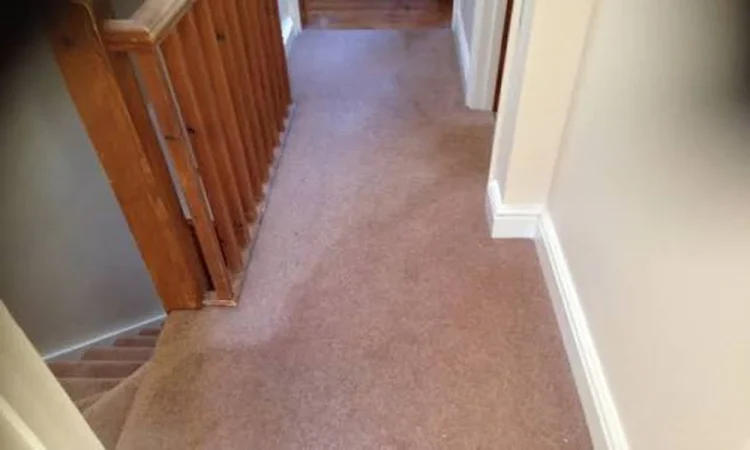
A carpet patch that changes from light to dark as you walk around it may involve the direction of the pile, rather than removable soil alone. Have an uncertain mark assessed before repeatedly cleaning it. For Richmond Hill residents considering an extractor, distinguishing an optical appearance from a stain helps define what cleaning can reasonably be expected to improve.
Notice what changes when you cross the room
The observation often begins in a familiar room. From the doorway, part of a plain carpet looks darker, as though someone spilled water across an irregular area. From the opposite side, the same area seems lighter. Nothing has been moved or cleaned between those views. The change in appearance is worth describing because it is different from simply finding a dark spot that looks much the same from every direction.
Do not turn that observation into a home diagnosis. A carpet can have soil, wear, shading and damage at the same time. A retailer or suitably experienced carpet professional can help assess what is present. Tell them whether there is a known spill, whether the appearance changes with viewpoint and whether the area has already been treated. Avoid repeatedly wetting a patch just to see whether the contrast will disappear.
Ordinary photographs can help explain the concern if they are taken from identifiable positions. Include a wider view so that the reviewer knows where the patch sits in the room. Two photographs from opposite ends may communicate more than a close-up with no setting. Keep lighting changes in mind when describing what you see, and do not edit the images to exaggerate the difference for emphasis.
Watermarking is a name, not a spill history
The Carpet and Rug Institute’s maintenance and troubleshooting bulletin describes shading as a change in pile direction rather than a change in colour. It also discusses pile reversal, sometimes called watermarking or pooling, which is usually permanent. Those terms explain why an appearance resembling a water mark does not, by itself, establish that water was spilled there.
That wording can be surprising to someone who has already named the patch “the stain.” Once the household adopts that name, every failed cleaning attempt may seem to call for a stronger one. It is more useful to describe an unresolved appearance than to build a treatment plan around an unconfirmed cause. The professional assessing the carpet can then explain whether the proposed cleaning target is actually removable soil.
The distinction also matters when the carpet belongs to someone else. In a furnished home, a shared property or a room being prepared for sale, avoid attributing the appearance to a particular occupant without evidence. A water-like shape is not a record of an incident. Preserve any known facts about actual spills separately from assumptions based on appearance, and let the assessment address both where necessary.
Temporary grooming marks and persistent pile reversal should not be casually treated as identical either. A carpet can show ordinary directional effects after routine care, while another condition may remain. Follow the manufacturer’s advice on care and obtain an assessment when the appearance concerns you. Aggressive brushing or repeated extraction to force a uniform look may be inappropriate for the material and should not be treated as the default remedy.
Clean for soil without promising uniform colour
A carpet with shading may still need ordinary cleaning. The question is whether the proposed method is suitable and what result is being promised. Explain the visual concern before agreeing to the work. Ask the person assessing it to distinguish the condition they expect cleaning to improve from an appearance that may persist. This makes the cleaning decision useful even when the room will not look uniformly coloured afterwards.
A relevant equipment enquiry can begin with Drying Equipment’s Richmond Hill carpet-cleaner page, once extraction is considered suitable for the carpet and the intended job. Describe the observed shading and any professional advice already received. Do not infer from a rental listing that the machine can reverse permanent pile changes or restore every visual feature of a previously used floor covering.
Consider a lounge carpet that has ordinary traffic soil near the entrance and a separate shadow-like patch beside the window. A sensible cleaning scope might address the removable soil while acknowledging uncertainty about the other area. The owner can decide whether that improvement is worthwhile on its own. There is no need to bundle the two conditions into an all-or-nothing promise that cleaning will make the entire surface look new.
If the shadow remains afterwards, return to the original explanation before booking another machine. Did the professional identify a condition expected to persist? Was the concern left unresolved? Did a new observation emerge? These questions lead to a more useful next step than counting how many times the same patch has been cleaned. Repetition is not evidence that the next treatment will address a different cause.
Judge the room under ordinary viewing conditions
Review the carpet when it is ready for normal use according to its care instructions. Use the room’s ordinary lighting and familiar viewpoints rather than searching for the angle that makes the patch look most dramatic. The purpose is to understand the appearance people will actually live with. Keep any final assessment connected to the carpet’s material, age, care history and the specific work that was undertaken.
Design decisions can then be made with clearer expectations. An owner may accept a characteristic appearance, discuss repair or replacement with the retailer, or simply continue appropriate maintenance. Moving furniture purely to hide an unexplained condition should not replace assessment where one is needed. Equally, a persistent visual effect does not automatically mean that a useful cleaning job failed.
A better-looking room does not always require every fibre to reflect light in the same way. Once the cause has been assessed, judge cleaning by the soil it was intended to address. That leaves room for an honest result and avoids chasing a shadow with another round of water.