Kitchen cabinet refacing has a fresh hero in 2025: Modern Rigid Thermofoil. Homeowners who want a stylish, durable update without the sky-high cost of full replacement are leaning into today’s advanced 3D laminates. These thermofoil doors and drawer fronts bring crisp lines, consistent color, and easy-clean finishes to both modern and transitional kitchens. And the latest generation isn’t the thermofoil of a decade ago, improved heat resistance, tougher topcoats, and elevated textures make it a legitimate alternative to painted wood for many households.
Why rigid thermofoil continues to rise in popularity in 2025
Rigid thermofoil (RTF) refers to a durable 3D laminate, typically PVC or PET, that’s thermoformed over precisely routed MDF. What’s changed in 2025 isn’t the basic process: it’s the quality of films and topcoats. Manufacturers now offer super-matte, anti-fingerprint surfaces, realistic woodgrains with embossed-in-register texture, and colorfast finishes that hold up to daily use.
Three factors are fueling the growth:
- Consistency and finish quality: Unlike painted wood, Modern Rigid Thermofoil delivers a uniform, factory-quality surface, no brush marks, no uneven sheen. That consistency shows on long runs of Shaker doors and slab drawer fronts.
- Fast, low-disruption projects: Refacing with thermofoil typically takes days, not weeks. Doors and drawer fronts are swapped, boxes are skinned, and hardware is updated with minimal demolition and mess.
- Real-world durability: Coffee splashes, sticky fingers, and the occasional pan bump are part of life. Thermofoil’s tough outer layer and fully wrapped edges resist most day-to-day abuse and wipe clean with a bit of mild soap.
Design-wise, the palette has exploded. From rift-cut oak and walnut looks to velvety deep navy and carbon black, there’s a breadth that suits minimalist lofts and cozy family kitchens alike, without the premium price tag of custom wood finishing.
Comparing thermofoil finishes with traditional wood cabinetry
Thermofoil and wood each have strengths: the right pick depends on priorities.
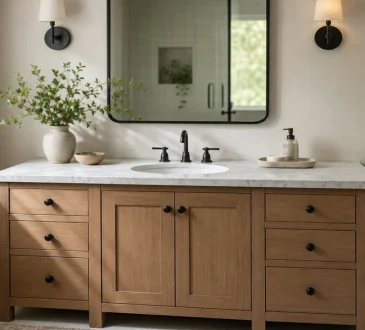
- Aesthetics: Wood is undeniably authentic. You get real grain movement, chatoyance, and the ability to stain or age it over time. Modern Rigid Thermofoil counters with incredible realism and a surgically clean look, perfect for those who want the style, not the maintenance. Super-matte foils provide that paint-like, low-sheen elegance without the chip-prone surface of painted doors.
- Seams and profiles: Because RTF is vacuum-formed over the face and edges, profiles like Shaker rails appear seamless. There’s no edge band line to collect grime. Wood doors rely on joinery and separate components: beautiful, but with visible transitions.
- Durability trade-offs: Quality thermofoil resists staining and everyday moisture better than painted wood. But, direct, prolonged heat can be a weakness (think the edge of a cabinet next to a slide-in range). Wood handles heat better but is prone to chips, hairline cracks at joints, and paint wear.
- Repair and refinish: Wood wins on refinishability. A scratched painted door can be sanded and repainted. Thermofoil can’t be refinished the same way: severe damage usually means replacement of that door. The upside is that matching replacements are easy to order.
Cost and timelines also differ: thermofoil leads for budget and speed: wood leads for long-term customization and heirloom appeal. Many homeowners land on a hybrid, thermofoil for the main run of cabinets and real wood accents (floating shelves, an island panel) for warmth and contrast.
Maintenance and cleaning advantages homeowners value most
One of thermofoil’s biggest selling points is how little fuss it requires. In busy kitchens, that matters.
- Daily cleaning is simple: A microfiber cloth and warm water with a drop of mild dish soap usually does the trick. Most fingerprints and food splatters release quickly, especially on today’s anti-fingerprint super-mattes.
- No special polishes: Unlike stained wood, there’s no need for conditioners. Unlike high-gloss lacquer, no swirl-remover routine.
- Stain resistance: Coffee, tomato sauce, and oil splatter wipe away without ghosting if cleaned promptly. Avoid leaving dyes (like turmeric) in contact for extended periods.
Common-sense precautions keep it looking new:
- Skip abrasives, scouring pads, and harsh solvents (acetone, lacquer thinner). They can mar the topcoat.
- Watch for heat blasts from ovens and dishwashers. Use manufacturer-supplied heat shields at adjoining panels and maintain recommended clearances.
- Dry standing water around sink bases. The wrapped edges protect well, but the MDF core, like any core, shouldn’t be soaked.
In short, Modern Rigid Thermofoil offers “wipe-and-go” upkeep that suits families, rental properties, and anyone who doesn’t want a high-maintenance finish.
How thermofoil delivers cost efficiency in remodeling projects
Refacing with thermofoil is one of the most cost-efficient ways to get a top-to-bottom visual transformation without tearing out functional cabinets.
Where savings come from:
- You keep the boxes: If cabinet boxes are structurally sound, refacing replaces only doors, drawer fronts, and external panels/skins. Labor, disposal, and material costs drop sharply compared to full replacement.
- Factory-finished parts: Modern Rigid Thermofoil doors arrive finished and consistent, eliminating paint-booth time and on-site finishing variables.
- Speed = lower labor: Shorter install windows mean fewer labor hours and less downtime without a kitchen.
Typical ranges in 2025 vary by region and scope, but homeowners commonly see:
- Thermofoil refacing: roughly 40–60% less than a full cabinet replacement. Many projects land between $7,500 and $18,000 for mid-size kitchens.
- Painted wood refacing: often higher due to finishing labor and longer timelines.
Small choices can stretch the budget further:
- Opt for slab or 5-piece Shaker over complex routed profiles.
- Use open shelves or glass accents selectively, where they make an impact.
- Update hardware and lighting strategically, high-contrast pulls elevate even modest door styles.
Shopping tip: many suppliers offer free sample chips, often via a quick “Click here” prompt, so a homeowner can evaluate color, texture, and sheen under real kitchen lighting before committing.
Style flexibility for modern and transitional kitchen designs
Thermofoil used to mean a handful of basic whites. Not anymore. Today’s Modern Rigid Thermofoil catalogs are deep, design-forward, and surprisingly tactile.
Popular 2025 directions:
- Super-matte neutrals: Soft white, warm taupe, and greige stay timeless and pair well with quartz and porcelain slab backsplashes.
- Deep, saturated tones: Ink blue, forest green, and carbon black in a flat, non-reflective finish bring drama without the fingerprints.
- Elevated wood looks: Rift-cut oak, straight-grain walnut, and textured ash replicate realistic pore patterns and tone variation.
- High-gloss modern: For contemporary flats, glossy whites and charcoals bounce light and visually enlarge compact kitchens.
Door styles and details:
- Slab fronts read ultra-modern, especially in handleless systems with integrated J-pull profiles.
- 5-piece Shaker doors lean transitional and farm-modern, softened with a slim rail for a current look.
- Edge detailing can be crisp or slightly eased: because foils wrap edges, the result feels seamless.
Thermofoil also plays well with mixed materials. Pair a walnut-look island with super-matte perimeter cabinets, add warm brass or brushed nickel pulls, and layer in natural elements, oak stools, a linen runner, for balance. For renters or multi-family units, consistent thermofoil finishes simplify unit-to-unit standardization while still giving designers a broad palette to keep spaces from feeling cookie-cutter.